
Net Zero’s High Street Takeover
How Energy Costs and Business Rates Fuel Organised Crime and Illegal Migration — And You Pay For It


There is a certain wry satisfaction in watching grand policy visions slam straight into the stubborn realities of the British high street—a spectacle that polite opinion has preferred, until now, not to examine too closely.
One observes, with the sort of dry amusement reserved for the more exquisite hypocrisies of our age, how both the Conservative and Labour parties have, in turn, sold net zero as an unqualified moral triumph — from the Tories’ 2019 manifesto vows to Labour’s “clean power by 2030” zeal — while the awkward downstream consequences have been quietly airbrushed from the official narrative.
The result is a self-reinforcing loop that polite opinion has so far preferred not to notice in its entirety. Net-zero energy levies and the April 2026 business-rates revaluation drive legitimate shops out, organised crime moves in through ghost directors and phoenix companies, the new criminal fronts offer profit and shelter to undocumented migrants, enforcement is hobbled by under-resourcing and legal constraints, and the taxpayer ends up footing the bill at every turn.
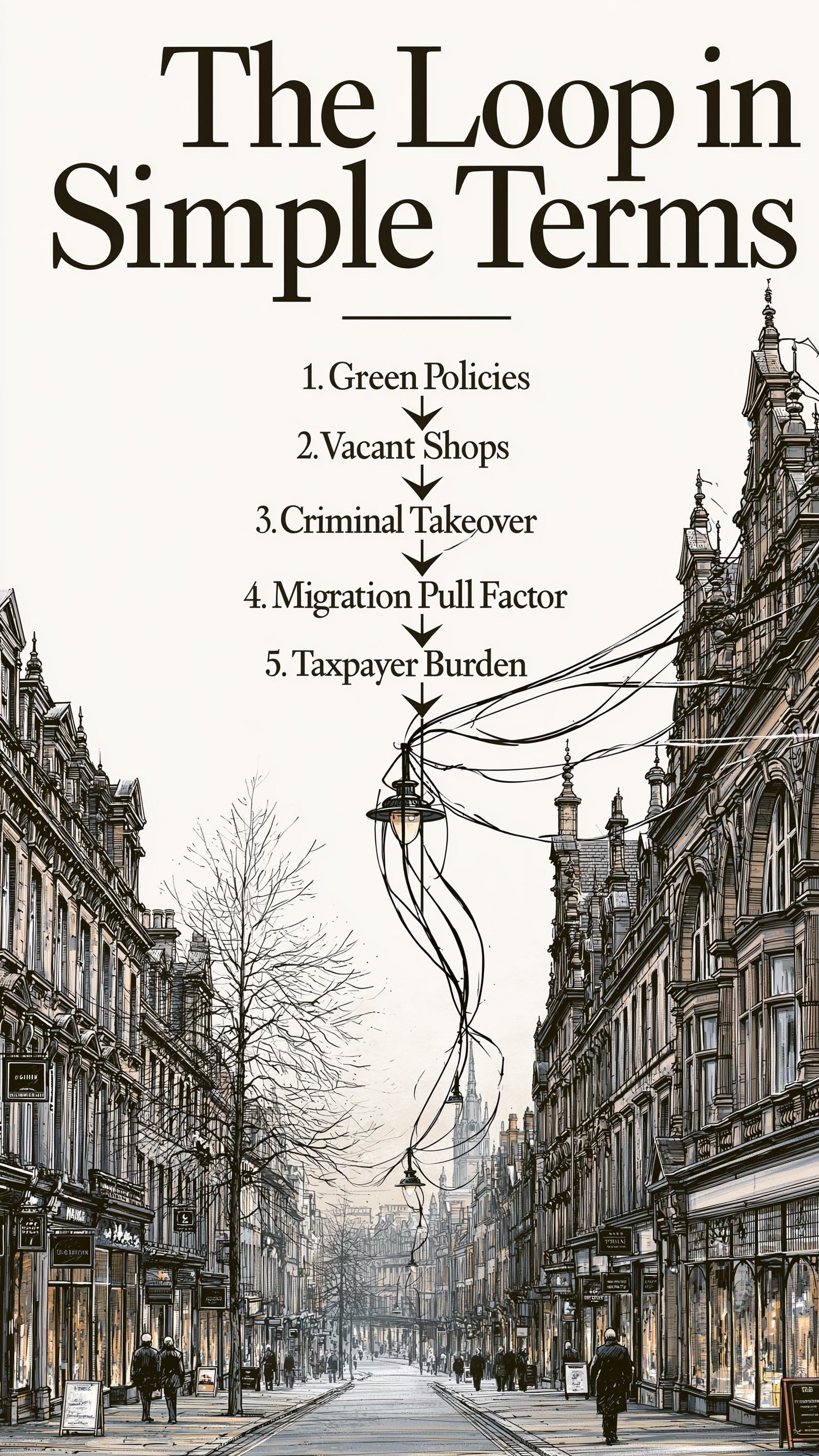
Mainstream narratives still treat high-street decline as a simple story of online shopping and post-Covid habits, while regarding organised crime and irregular migration as entirely separate problems.
Yet primary evidence, however, tells a far less convenient tale.
The Human Cost to Enforcement Officers
The human face of this loop is impossible to ignore. Consider the unsettling case of one Trading Standards officer known only as “Mandy”.
In the BBC investigation that informed the Chartered Trading Standards Institute’s report Hidden in Plain Sight (published 30 April 2026), she spent months pursuing a Kurdish-linked gang controlling more than fifty high-street premises.
In return she received explicit death threats, including a midnight telephone call promising to kill her husband, kill her, and burn down their home.
Her new car was rammed twice, once at a cost exceeding £10,000.
She and her husband were forced to sell their property and employ multiple removal firms on police advice to conceal their new address.
Such experiences are far from isolated.
The CTSI survey of more than 2,000 officers found that 72 per cent had personally faced intimidation, threats of violence, or physical assault.
Such experiences are far from isolated—an outcome that might, in a less enlightened age, have prompted a more searching look at the upstream policies feeding the problem.
One would, of course, be disappointed.
The Loop Polite Opinion Prefers to Overlook
Britain’s high streets in the spring of 2026 offer a study in unintended consequences almost too neat to be accidental.
Savills reports vacancy rates on principal shopping streets at 13.2 per cent in Q1 2026, a modest improvement from 13.4% the previous quarter but still stubbornly elevated in many provincial centres.
The causes are not mysterious; they flow directly from the net-zero energy levies that both Tory and Labour governments have defended as necessary and virtuous — an upstream subsidy for the downstream occupation that would follow, as one might have predicted.
The combined effect has been almost artistic in its precision—an opening movement in the political choreography that would later prove so flawlessly self-defeating.
First come the net-zero-driven energy costs.
Ofgem’s final determinations for the RIIO-ET3/RIIO-3 price-control period, published in December 2025, confirmed that Transmission Network Use of System charges would rise by an average of more than 60 per cent in 2026/27.
Non-commodity costs now account for over 60 per cent of a typical business electricity bill.
One cannot help but note the exquisite coincidence. The very measures sold as saving the planet have made staying in business markedly more expensive.
On top of this lands the April 2026 business-rates revaluation.
The Valuation Office Agency’s latest assessment, implemented on 1 April, introduced five new multipliers, imposing an additional £600 million burden on major operators.
The British Retail Consortium and UKHospitality have warned that the combined pressure is accelerating closures among independent shops and mid-sized chains.
Together the effect has been, one notes with a certain dry amusement, impressively precise.
And here the irony becomes clear.
The Elegant Symmetry: How Green Policies Feed Criminal Takeover
The Chartered Trading Standards Institute’s report Hidden in Plain Sight states the mechanism with a clarity that ought to embarrass those who prefer their policy failures to remain discreet.
Illegitimate businesses routinely avoid the required taxes and duties.
They undercut law-abiding retailers, strain the overheads of those still clinging on, and generate still more vacancies for the next wave of criminal occupation.
The report describes this as a self-perpetuating dynamic, “This activity puts more pressure on the viability of legitimate high street shops and, should they be forced to close, may lead to more illegitimate businesses taking their place on the high street.”
The scale is striking.
Ninety-nine per cent of the officers surveyed reported a significant increase in cash-intensive businesses since 2020.
In some areas, officers estimated that up to half of mini-marts and vape shops were linked to organised crime groups.
These are not marginal anomalies, they have become a structural feature of the modern high street.
Mainstream commentary still frames high-street decline as a story of online shopping and changing consumer habits.
The CTSI report, grounded in the professional testimony of officers on the front line, tells a different tale, a policy-induced vacancy boom quietly colonised by networks that pay none of the costs imposed on everyone else.
The very measures intended to build a greener, fairer economy have, in practice, subsidised its criminal shadow — one almost admires the neatness of the arrangement.
Where Net Zero Meets the Black Market
The transition from policy-induced vacancy to criminal occupation is swift. The transformation from retail front to migration conduit proceeds with striking efficiency.
What begins as an economic opportunity created by net-zero levies and business-rates reform ends as something far more consequential, a documented mechanism that sustains irregular migration while polite opinion continues to treat climate policy, fiscal design and border control as entirely separate domains.
The National Crime Agency’s Operation Machinize 2 offers the clearest snapshot yet.
Across the United Kingdom, officers visited and raided 2,734 high-street premises.
They made 924 arrests, seized or froze more than £10.7 million in suspected criminal proceeds, and destroyed illicit goods valued at £2.7 million — including 4.5 million illegal vapes and 4.5 million cigarettes.
Among the items recovered were notebooks written in foreign languages.
When translated, they contained not only orders for thousands of packets of contraband cigarettes but also explicit instructions on how to complete asylum application forms with fraudulent details — changing nationality, for example, to avoid deportation.
The BBC’s undercover investigation, which helped inform the CTSI study, mapped a single Kurdish-linked network controlling more than one hundred high-street premises nationwide.
Ghost directors registered the companies, undocumented migrants or failed asylum seekers ran the shops on the ground, charged up to £300 a month for the privilege.
Ministers themselves have described these operations as a “pull factor” for small-boat crossings across the Channel.
The economic conditions created upstream by net-zero infrastructure investment and fiscal rebalancing have, in effect, subsidised the downstream infrastructure of irregular migration.
One observes here a symmetry that ought to provoke more curiosity than it does.
Policies sold as moral imperatives — saving the planet through higher energy costs, rebalancing the tax base through rates reform — have inadvertently widened the welcome mat for networks whose primary commodity is not merely illicit goods but continued presence on British soil.
The mainstream narrative still frames high-street crime as a policing issue and illegal migration as a Home Office problem.
The primary evidence shows the two are linked by the very economic vacancies that net zero and the 2026 rates changes helped create.
The loop has now acquired its migration dimension.
The Pull Factor That Dare Not Speak Its Name
Trading Standards services, the frontline regulator in this arena, operate under severe constraints that were never designed for the scale of serious organised crime now evident on the high street.
Local authority budgets have been cut by up to 50 per cent over the past decade.
Officers possess significant investigatory powers under the Consumer Rights Act 2015 but lack any statutory authority to make arrests, as such, they must call upon police support that is not always immediately available.
Closure orders under the Anti-social Behaviour, Crime and Policing Act 2014 are limited to an initial maximum of three months, extendable once for a further three months — a statutory ceiling that organised networks routinely circumvent by phoenixing under new corporate identities at Companies House.
Proportionality requirements derived from Articles 8 and Article 1 of Protocol 1 of the European Convention on Human Rights add a further layer of judicial caution — another elegant obstacle that makes swift disruption of these criminal fronts remarkably difficult.
The human cost is measurable.
The CTSI survey found that 96 per cent of officers had encountered serious organised crime in the course of their duties, while 72 per cent had personally experienced intimidation, threats of violence, or physical assault.
Government responses exist — the High Streets Illegality Task Force, £10 million annual funding for three years, and the CTSI’s own ten-point plan calling for extended closure powers and £100 million phased investment in Trading Standards — yet they address symptoms rather than the integrated loop.
The migration nexus remains the element that dare not speak its name in full, criminal high-street fronts that provide both profit and continued presence for those whose asylum claims are coached with fraudulent precision, as uncovered in NCA Operation Machinize 2.
One might almost admire the doctrinal consistency with which the state creates the problem and then ties its own hands in solving it.
The Taxpayer’s Double Burden
The loop reaches its quiet conclusion in the place where all policy consequences eventually land, the taxpayer’s wallet.
The criminal enterprises that have colonised the vacancies created by net-zero energy levies and the April 2026 business-rates revaluation do not simply evade their own costs, they generate a measurable and growing burden on public finances.
The latest official estimates place the annual tax gap from illicit tobacco alone at £1.8 billion in lost excise and VAT.
Broader serious organised crime, according to Home Office and National Crime Agency assessments, costs the United Kingdom at least £47 billion each year — a figure acknowledged to be an understatement.
This is the elegant fiscal reckoning.
The same policies presented as virtuous have helped create the conditions in which organised crime groups thrive.
Those groups, in turn, deprive the Exchequer of revenue that might otherwise have funded relief on precisely those energy levies or more generous rates support for legitimate retailers.
The taxpayer therefore pays twice. First through elevated bills that accelerate legitimate closures, and again through the lost revenue and enforcement costs required to manage the criminal economy that fills the resulting void.
Polite opinion treats these as separate ledger entries.
The primary data shows they are entries in the same ledger — a quiet hypocrisy that few seem eager to acknowledge.
The Reckoning Britain Can No Longer Avoid

One observes, with the same wry satisfaction that opened this piece, how the pieces of the puzzle now slot together with almost indecent precision.
Net-zero energy levies and the April 2026 business-rates revaluation clear the high street for occupation, organised crime moves in and exploits the vacancies, the resulting criminal fronts furnish both profit and shelter for undocumented migrants, enforcement, hobbled by statute and chronic under-resourcing, watches from the sidelines, and the taxpayer, having already subsidised the upstream virtue-signalling, foots the bill for the downstream consequences at every turn.
Both main parties have, in their turn, sold net zero as an unqualified moral triumph — the Conservatives through their 2019 manifesto and legally binding targets, Labour through its “clean power by 2030” mission — while the awkward downstream realities have been quietly airbrushed from the official narrative with all the discretion one has come to expect.
The documented evidence from Ofgem, the Chartered Trading Standards Institute and the National Crime Agency reveals the symmetry, policies presented as cost-free progress have quietly created the very vacancies and incentives that organised crime and irregular migration have so efficiently colonised.
Polite opinion may continue to treat these domains as separate, yet the loop has acquired a self-perpetuating momentum that few can any longer pretend not to notice.
In the end, Britain is left contemplating not merely a policy failure, but a piece of political choreography so self-defeating that even the most jaded spectator might permit himself a small, dry smile of reluctant admiration.
Decarbonisation has always been a campaign of the elites to keep the oil etc for themselves and impoverish the rest of us. Quite intentional.