
Britain Didn't Fail to Build Homes. It Was Squeezed From Every Direction, on Purpose.
Taxed on one side, delayed on the other, blamed for both. 3,950 construction firms went under in a single year. Westminster did the squeezing — and let the house-builders take the fall.


Andy Burnham, the clear frontrunner to become Britain’s next Prime Minister, has pledged to deliver the biggest council house-building programme since the post-war period as part of his “No 10 North” devolution agenda. It is a fine ambition. It is also, on the construction industry’s own arithmetic, somewhere between heroic and fictional — not because the goal is misguided, but because successive governments spent the better part of a decade quietly ensuring the country would lack the capacity to achieve it.
He will, no doubt, turn to that arithmetic shortly. The figures are not encouraging, which is presumably why few have troubled him with them.
On a Monday morning in February 2026, a supplier arrived at a construction site in London for a scheduled delivery, fully expecting the usual bustle of activity. Instead, he found the gates firmly locked. A notice from the administrators had been pinned there with the sort of understated finality one associates with a quiet library overdue slip or a particularly courteous eviction notice.
No prior warning. No desperate phone calls in the night. Just silence, a sturdy padlock, and the unceremonious end of a company that had been raising buildings across Britain since 1884.
Jerram Falkus had survived the Somme, the Blitz, Black Wednesday, and the 2008 financial crisis. Yet it could not withstand a profit margin of a mere 0.08 per cent in an industry being dismantled — with the meticulous, almost loving care of a particularly dedicated civil servant — from every conceivable direction at once.
This is not simply the unfortunate tale of one company’s demise. It is a masterclass in how to manufacture a housing crisis, methodically, across successive governments of varying hues, with generous infusions of public money artfully redirected toward other priorities, and the quiet acquiescence of both major political parties.
Ten Firms A Day
In the twelve months to November 2025, 3,950 construction firms collapsed in the United Kingdom — more than ten every single day, a grim rhythm that shows little sign of abating. Construction now accounts for 17 per cent of all corporate insolvencies, a dubious honour it has claimed for the fourth consecutive year.
A further 108,213 firms languish in significant financial distress, while nearly 10,000 teeter in critical condition — one bad month, one delayed payment, or one more regulatory surprise from following Jerram Falkus through those locked gates, as the insolvency specialists at Begbies Traynor have so delicately observed.
New homes delivered in England during 2024–25 fell to 208,600 — a six per cent decline on the previous year. In London, only 4,170 new homes even began construction, a staggering 72 per cent year-on-year fall, in a city that had managed more than 10,000 starts every year since 1946.
The government’s stated aim remains 300,000 homes annually. One notes, with a certain dryness, that current delivery falls somewhat short of this ambitious target. The suggestion that these figures might be connected is not merely tempting, it is, to borrow a phrase, unavoidable.
How A Construction Firm Dies
The mechanism by which these firms meet their end is worth understanding, for it is rarely explained with the candour it deserves. These are not companies undone by reckless over-expansion or foolish speculation. They are ensnared in a structural trap that has become all but unsurvivable since inflation arrived and showed no inclination to depart at the appointed hour.
A contractor wins a project, signs a fixed-price contract, and agrees to build something for a set sum determined in more reasonable economic times. Then inflation strikes. Materials become more expensive immediately. Labour costs rise without delay. The contractor builds at today's inflated rates and waits — thirty, sixty, ninety days — for payment calculated at yesterday's prices. On paper, the business may appear profitable. In reality, it is insolvent.
Caldwell Construction, 400 employees, £58 million in revenue, recorded a £170,000 loss in 2024–25 after a £2.9 million profit the year before, its directors citing "margin pressure arising from fixed-price legacy contracts." FK Group, trading since 1979, followed. EJ Taylor and Sons — 140 staff, £41 million turnover — entered administration the same day. Jerram Falkus joined them shortly after. Different sizes, different regions, different specialisms, felled within weeks of one another by the identical quiet pressure. The list goes on.
Administrators, in their characteristically soothing tones, speak of “challenging trading conditions.” Those less invested in polite euphemism might prefer the term “systemic failure” — a failure with causes that are not only identifiable but, in many cases, directly traceable to decisions taken in Westminster.
The Legislative Avalanche.

While this quiet demolition unfolded, what have governments been doing? Legislating. Enthusiastically. Continuously. With what can only be described as an impressive indifference to foreseeable consequences.
In April 2025, employer National Insurance contributions rose to 15 per cent, with the threshold dropping from £9,100 to £5,000. An immediate, unavoidable increase in payroll costs for the most labour-intensive industry in the economy — precisely the sort of targeted assistance one might design if one wished to accelerate collapse.
The Building Safety Regulator, established in the necessary aftermath of the Grenfell tragedy, spent the period from October 2023 to March 2025 deciding 69 per cent of all applications as invalid, withdrawn, or rejected. For new-build high-rise applications, the figure reached 77 per cent.
Median approval times stretched to 25 weeks against a prescribed twelve. The House of Lords Industry and Regulators Committee, reporting in December 2025, described the delays as “unacceptable” and called for “urgent” improvements.
In a masterstroke of timing, the chair of the Building Safety Regulator was nominated for a peerage by the prime minister, Keir Starmer, that very week. One pauses to allow that particular detail to settle.
October 2026 brings the Building Safety Levy, adding an estimated £3,000 on average to every new home. The Home Builders Federation has politely suggested it might be scrapped amid existing pressures. The government has, with equal politeness, declined.
January 2027 sees the Carbon Border Adjustment Mechanism apply levies to imported aluminium, cement, iron, and steel — the very materials from which buildings are constructed. Costs rise again.
Then comes the Future Homes Standard in March 2027, requiring all new homes to cut carbon emissions by 75–80 per cent. The government’s own impact assessment placed the additional cost at £4,350 per home. Independent estimates from those who have actually laid bricks suggest £15,000 to £25,000.
Regulations since 2020 have collectively added £76,000 to the cost of building a single home, according to industry calculations. Every item on this list was known, warned about, and received before the Autumn Budget 2024.
It is worth a historical footnote, in the spirit of accuracy rather than recrimination, that the Future Homes Standard represents the deferred bill for a decision taken in 2015.
George Osborne scrapped the Zero Carbon Homes Standard — a policy that would have required energy-efficient homes from the outset, cancelled just months before implementation after nine years of preparation.
The Energy and Climate Intelligence Unit calculated that by 2020 this had already cost new-build homeowners more than £2 billion in higher energy bills. The industry successfully lobbied to avoid the expense at the time. The bill has since been presented, with interest, to homeowners, public finances, and the very firms now expected to meet standards made vastly more expensive by years of delay.
The Apprenticeship Levy: £1.4 Billion And A Worsening Problem
In 2017, the Conservative government introduced the Apprenticeship Levy — a 0.5 per cent payroll tax on large employers, ring-fenced to fund training and solve Britain’s skills shortage. Construction firms have contributed dutifully ever since. Construction apprenticeship starts have fallen every year since.
The skills shortage in 2026 — with 72 per cent of firms describing it as severe — is worse than when the levy began.
Where did the £1.4 billion go? Quite legally, within the rules as written, it was redirected to management training, leadership courses, and qualifications bearing little resemblance to producing bricklayers or electricians. The government collected £1.4 billion from the construction industry to solve a skills crisis. The crisis worsened annually. The money trained middle managers.
Britain needs, by its own analysis, 1.3 million new skilled tradespeople by 2033 — including 111,000 electricians and 90,000 plumbers. The system produces approximately 20,000 construction apprentices per year.
At that rate, closing the gap would take 65 years. The levy has been running for eight, during which the gap has widened. Labour inherited this elegant mechanism and, with admirable continuity of purpose, left it untouched.
The Regulator That Changed Its Mind
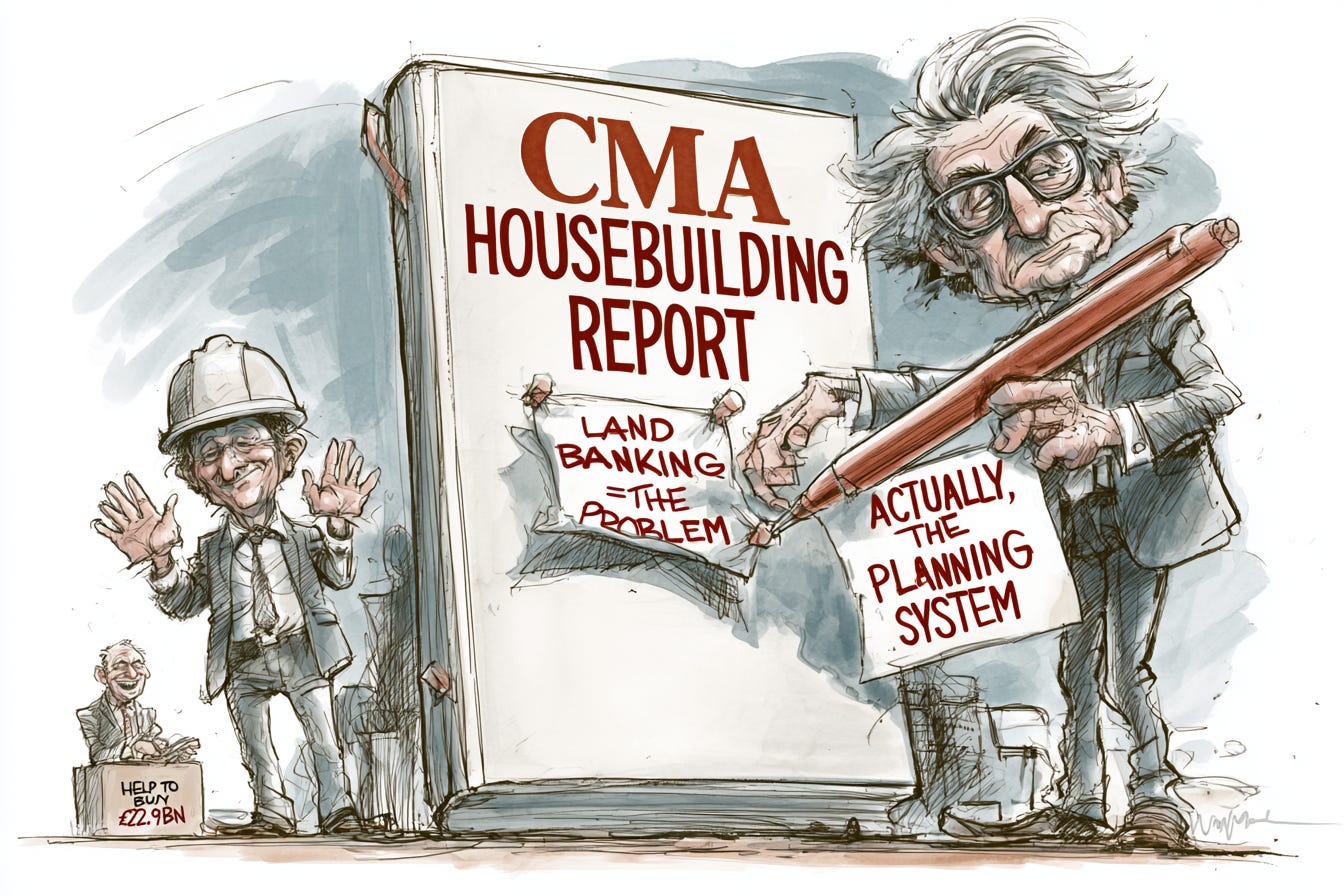
Here is the detail that complicates, rather than resolves, everything preceding it. In February 2024, the Competition and Markets Authority confirmed Britain's largest housebuilders — Barratt, Bellway, Berkeley, Persimmon, Taylor Wimpey and Vistry among them — control land equivalent to 522,000 short-term plots with planning consent already granted. One might have expected a satisfying exposé of cartel-like hoarding. The regulator, with characteristic restraint, declined to deliver one.
Land banking, it turns out, was not the cunning cause of the shortage but its predictable symptom — the entirely rational response of developers operating inside a planning system so slow and capricious that holding consented land became a necessary hedge rather than an act of sabotage.
This is a less gratifying narrative than shadowy developers hoarding half a million homes out of sheer avarice. It has the distinct disadvantage of being true. None of which absolves the major housebuilders so much as politely relocates the blame to where the rest of this article has already directed it, Westminster.
The CMA did open a fresh investigation into suspected information-sharing among eight firms, while quietly noting — in the regulator’s finest tradition of undercutting its own headlines — that this too was unlikely to explain the scale of undersupply.
Meanwhile, the £22.9 billion spent on Help to Buy, which the National Audit Office found inflated prices by up to 20 per cent, paid for a chief executive’s £75 million bonus in a year when the scheme accounted for half his company’s sales. No regulator has seen fit to walk that one back.
The Bill Nobody Has Costed
Which returns us to Mr Burnham. “Biggest since the Second World War” has an actual benchmark attached to it. Council housebuilding peaked at roughly 200,000 to 250,000 homes a year in the early 1950s, averaging 126,000 a year across the three decades that followed. Council completions last year stood at roughly 8,300 — 4 per cent of all new homes built in England. The gap between the benchmark his own words invoke and where the country currently stands is not a rounding error. It is the better part of a quarter of a million homes annually, conjured from nothing.
The construction industry’s own training body has already done the relevant sum, for a considerably smaller ask. CITB’s current workforce outlook puts the total additional labour required simply to meet existing housing and retrofit targets — not Mr Burnham’s pledge, the targets already on the books — at 41,200 extra workers a year through 2030, rising to 110,000 a year by some measures. That is the bill for ambitions considerably more modest than the one outlined at Makerfield. Nobody has yet totted up what his pledge specifically adds on top of it, which is either an oversight or a mercy.
CITB did, to its credit, report a 43 per cent rise in apprenticeship starts last year, helped along by a dedicated recruitment scheme. This is genuine progress, and ought to be acknowledged as such. It is also a 43 per cent rise from a base the rest of this article has already explained, funded in part by the same levy that spent eight years training middle managers instead of bricklayers. Closing a gap measured in tens of thousands of workers a year, with a pipeline only now recovering from a decade of misdirection, on a timetable set by a leadership contest rather than an industrial strategy, is not a plan. It is a hope wearing a plan’s clothing.
Credit Where Credit Is Due
Credit, such as it is, must be shared. This crisis is a genuinely cross-party accomplishment.
The Conservatives scrapped Zero Carbon Homes in 2015, passing the cost forward. They introduced an Apprenticeship Levy that collected £1.4 billion and trained middle managers. They funded Help to Buy to the tune of £22.9 billion, inflating prices in a market the CMA later found was constrained by planning delay, not by the housebuilders sitting on it. They created a building safety regulator without resourcing it. They received the CMA’s findings and departed office having done nothing.
Labour introduced the largest employer payroll cost increase in a generation into an industry already running on margins of 0.08%. They preserved every broken mechanism they inherited. They nominated the chair of the organisation the House of Lords had just described as causing “unacceptable” delays to a seat in the House of Lords.
The consequence of all this is not abstract. It is Caldwell Construction — 400 people, £58 million in revenue, gone. It is FK Group, trading since 1979, gone. It is EJ Taylor and Sons, 140 workers, gone. It is 3,950 firms in a single year, more than ten every day, taking with them the electricians, the plasterers, the scaffolders, the timber merchants and the plant hire firms that depended on them.
It is 108,213 more firms currently in significant distress, waiting for the bad month that finishes them. It is a kitchen that costs 34% more than it did two years ago and a builder who cannot come for six months. It is a young family who had to withdraw from buying a home because the building delays ran out their mortgage offer.
None of this was planned. That is not an excuse. It is the most damning verdict available — that two governments, between them, created the conditions for the worst construction crisis in a generation not through malice but through the steady, compounding preference for decisions that were convenient this Parliament and catastrophic for the next.
The gates at Jerram Falkus remain locked. The supplier, like so many others, has nowhere to deliver. Mr Burnham promises the biggest council house-building programme since the Second World War. He will require, among other things, contractors who are not in administration, tradespeople the Apprenticeship Levy was supposed to produce rather than management seminars, and land not languishing in a developer’s bank while the planning system searches for its apology.
None of these, alas, exists in the quantities required. The CITB has already done the sums. Mr Burnham has not yet asked to see them. The emergency, as emergencies tend to do, is not waiting. Westminster, with its customary composure, continues drafting its next press release on solving the housing crisis.
Like his many predecessors, Burnham will deliver nothing other than the Agenda 2030 goals - “you will own nothing and be happy”.