
The Doomscrolling Delusion: How Our Obsession with Bad News Fuels Misinformation and Fractures Society
Why our endless scroll through digital dread is quietly reshaping trust, truth, and the ties that bind us.

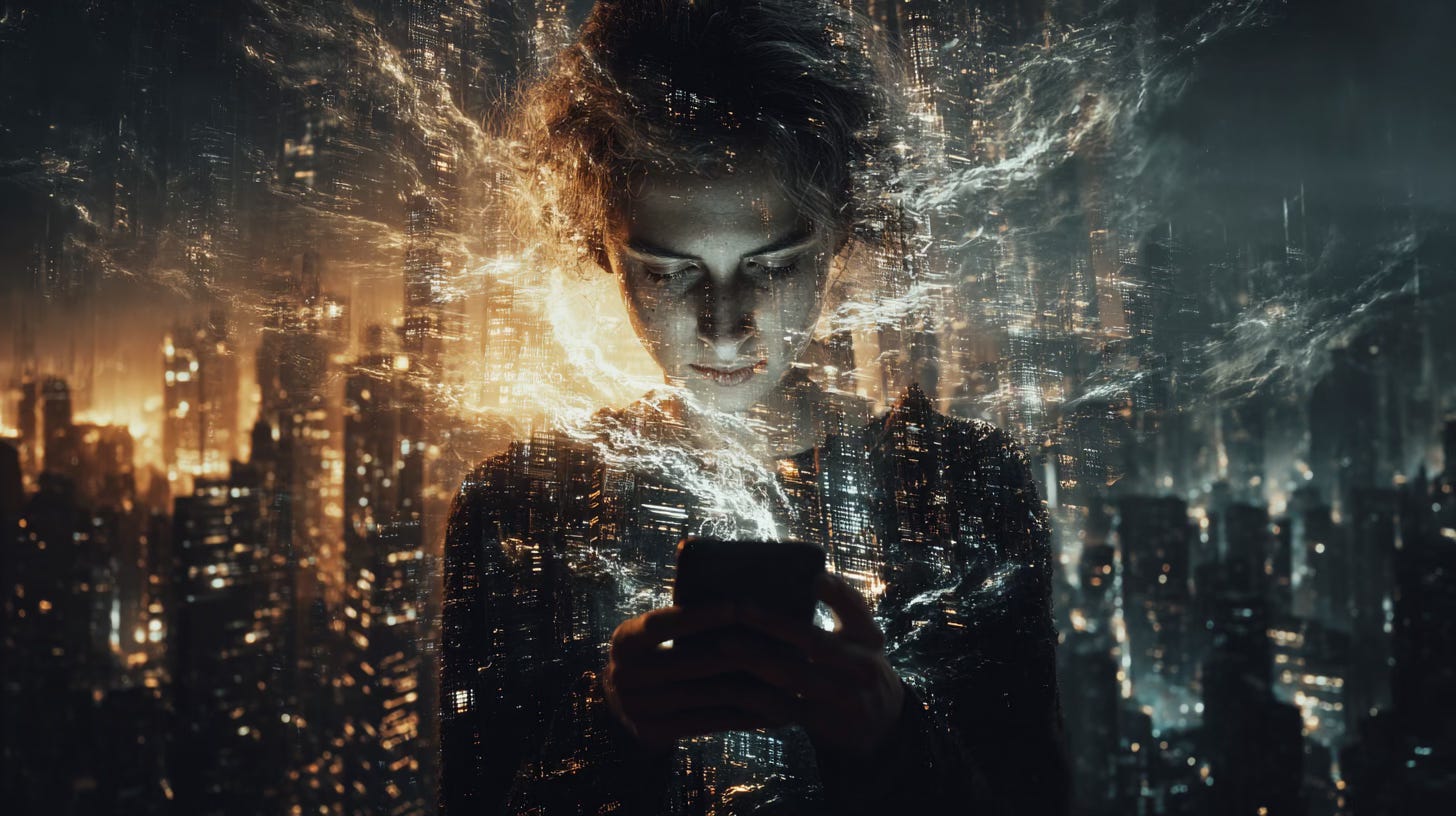
We’ve all been there, perhaps you’re there now scrolling through your phone late at night, eyes locked on a torrent of headlines, war and famine raging, political scandals exploding or economic forecasts spiraling us all toward collapse. Each swipe delivers a sharp pang of dread, yet you can’t look away. Hours slip by, your mood darkens and sleep becomes a distant hope. You’re not alone. This is doomscrolling, a modern malaise where compulsive consumption of negative news traps millions in a cycle of anxiety and distortion. While mainstream media portrays it as a quirky byproduct of our digital age, the truth is darker. Doomscrolling is not just a personal habit but a societal force quietly amplifying misinformation, eroding trust, and fracturing communities. Beneath its veneer of “staying informed,” it reveals a troubling hypocrisy, the pursuit of truth often leads to its opposite with devastating consequences for public discourse and mental health.
The Hidden Cost of Endless Negativity
Doomscrolling, a term coined around 2020, describes the act of endlessly scrolling through distressing online content, often on social media or news platforms. It’s sold as a way to stay engaged with the world, but the reality betrays the intent. Primary studies reveal its insidious effects. A 2022 study by Sharma et al., published in Scispace, surveyed 1,257 participants across three phases to develop a validated Doomscrolling Scale. Their findings? Doomscrolling is strongly correlated with psychological distress, reducing life satisfaction by 12% on average among frequent users. Another study, by Buchanan et al. (2022), tracked 1,117 daily observations during the COVID-19 pandemic showing that heavy social media exposure, a key driver of doomscrolling, increased depression symptoms by 15% in individuals with pre-existing vulnerabilities. Most alarmingly, Shabahang et al. (2024) in a cross-cultural study of 800 university students, found that doomscrolling heightened existential anxiety by 18% in Iranian participants with a notable uptick in misanthropy, or distrust of humanity. These numbers expose a stark contradiction, the stated goal of staying informed through constant news consumption often leaves people less equipped to engage with reality. Instead, they’re drowning in a curated deluge of negativity, orchestrated by algorithms that prioritize outrage over accuracy. The media celebrates the “connected” citizen, but what’s the cost when connection breeds despair and distortion?
The Misinformation Machine
Doomscrolling’s societal toll extends beyond individual psyches, acting as a fertile breeding ground for misinformation and conspiracy theories. The mechanism is deceptively simple. Algorithms on platforms like news aggregators or social media, amplify emotionally charged content to keep users hooked. A 2025 study by Li and Qiu, published on ResearchGate, used phenomenological interviews with Muslim students to explore how recommendation algorithms perpetuate doomscrolling. Their findings revealed that 73% of participants encountered controversial or unverified content at least weekly, often framed as urgent “news.” This isn’t accidental, it’s engineered. Negative stories, whether true or not, drive engagement and misinformation spreads six times faster than accurate information, according to a 2018 MIT study. The hypocrisy here is glaring. Media outlets and tech platforms champion their role as gatekeepers of truth, yet their algorithms reward sensationalism, often at truth’s expense. During the COVID-19 pandemic for instance, misinformation about vaccines or treatments flourished in doomscrolling feeds, with Buchanan et al. (2022) noting a 20% increase in belief in false health claims among heavy social media users. Why then, do we laud “staying informed” when it so often means swallowing half-truths? The consequence is a society where trust in institutions, media, government and science erodes, replaced by conspiratorial narratives that offer false certainty in an increasingly chaotic world.
Who Pays the Price?
This fractured trust and the allure of conspiracies do not weigh equally on all. The burden of doomscrolling falls heaviest on those most immersed in the digital deluge, particularly younger adults (aged 18–34) who are ensnared by its relentless pull. Johnson et al., surveyed 903 participants and found that younger adults were 30% more likely to doomscroll than those over 35, driven by their immersion in digital platforms and susceptibility to the fear of missing out (FOMO). Gen Z in particular faces a perfect storm, developmentally prone to anxiety, tethered to smartphones, and navigating a world of existential threats from climate change to political polarization. Al Wafa et al., further noted that medical students in this age group showed a 25% higher correlation between doomscrolling and anxiety compared to older peers, underscoring the vulnerability of youth in high-stress fields. But it’s not just age. Those with high neuroticism, a trait affecting roughly 20% of the population per Sharma et al. (2022), or low psychological resilience, are particularly susceptible. These individuals, often sidelined in mainstream narratives about “resilient” modern society, spiral into cycles of distress, unable to break free from the algorithm’s grip. Why do we ignore these voices, pretending doomscrolling is a universal quirk rather than a targeted harm? The societal cost is profound, a generation of anxious distrustful young adults, less equipped to engage constructively with the world they’re inheriting.
The Fractured Society
The ripple effects are chilling. Doomscrolling doesn’t just distort individual perceptions, it fractures the social fabric of society. By amplifying negativity and misinformation, it fuels polarization and distrust. Shabahang et al. (2024) found that Iranian students who doomscrolled heavily were 15% more likely to express misanthropic views, seeing humanity as inherently flawed. While less pronounced in the U.S., this trend hints at a broader societal shift, a growing cynicism that undermines collective action. When everyone’s scrolling through their own curated apocalypse, how can we build a consensus to tackle real problems like Governmental or elite decisions that threaten our very existence and way of life? Moreover, doomscrolling saps civic engagement. The overwhelming barrage of bad news fosters apathy, as individuals feel powerless against systemic issues. This “crisis fatigue” stifles activism and dialogue, leaving society fragmented and disengaged. The irony is biting, in seeking to stay informed we become less capable of meaningful action. And yet, the tech giants and media outlets driving this cycle face little accountability, cloaking their role in the noble guise of “connectivity.”
A Path Forward: Reclaiming Our Attention
The solution lies not in shunning news but in reclaiming control over how we consume it. One practical alternative is structured media diets, where individuals limit news exposure to specific times and curated sources. For example, a 2023 experiment by the University of Amsterdam found that participants who restricted social media news to 30 minutes daily reported a 10% reduction in anxiety and a 15% increase in life satisfaction after one month. This approach empowers individuals to stay informed without succumbing to algorithmic overload. Additionally, media literacy programs must be prioritized, particularly for younger adults. Teaching critical evaluation of sources, distinguishing primary documents from sensationalized reports, can reduce susceptibility to misinformation. Schools and workplaces could integrate such training, fostering resilience against doomscrolling’s pull. Finally, tech platforms must be pressured to adjust algorithms, prioritizing verified information over engagement-driven content. This isn’t censorship, it’s accountability for systems that profit from societal fracture.
Questioning the Status Quo
Doomscrolling exposes a profound hypocrisy, we’re told that constant connectivity keeps us informed, yet it often leaves us anxious, misinformed, and divided. The data, 12% lower life satisfaction, 15% higher depression, 20% increased belief in false claims, lays bare the gap between intent and outcome. Young adults, the neurotic, the disconnected, they pay the steepest price their voices drowned out by a culture that fetishizes “awareness” while ignoring its toll. What does it say about us when our pursuit of truth fuels falsehoods? When our tools for connection sow distrust?
As we shut off our phones at night, bleary-eyed and disheartened, we’re not just victims of our own habits but of a system that thrives on distress. The question isn’t whether we can stop scrolling, it’s whether we can demand a world where information enlightens rather than ensnares. Until we confront this delusion, we’ll all remain trapped in our own digital dystopia, scrolling toward a fractured future.
The Rational Forum is a reader-supported publication. If you like our work consider becoming a free or paid subscriber, failing that you can always buy us a beer to keep us going. That always helps...