
The ECHR Mirror: One Doctrine, Two Politically Inconvenient Symmetries
The procedural mirror that embarrasses everyone in turn

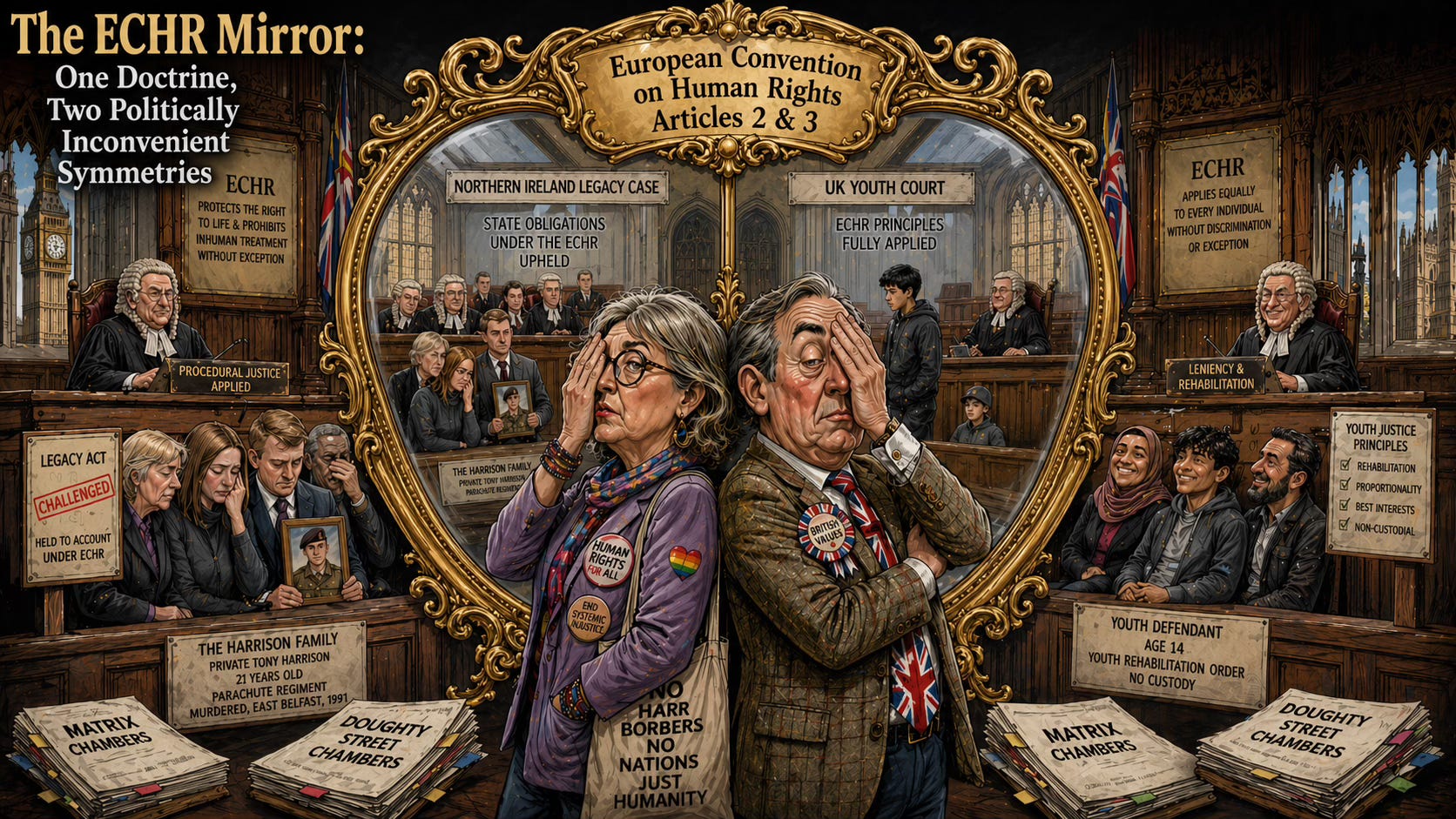
One observes, with the sort of mild amusement reserved for particularly elegant hypocrisies, how the European Convention on Human Rights has become Britain’s favourite political football.
To the right it is an undemocratic straitjacket on the popular will, to the left it is the last redoubt of decency against the barbarian hordes. Both sides are half-right, yet both remain wholly blind to the same awkward truth, the Convention is not a mere partisan battleground but a procedural mirror. It reflects back whatever facts are placed before it, with a consistency that embarrasses everyone in turn.
The Case That Polite Opinion Prefers to Overlook
Consider a case that has received curiously little sustained examination. In 2023 and 2024, Lord Richard Hermer KC—then still at Matrix Chambers—was instructed by the family of Private Tony Harrison, a 21-year-old Parachute Regiment soldier murdered in East Belfast on 19 June 1991 by the Provisional IRA while off-duty and visiting his fiancée.
The relatives challenged the Northern Ireland (Legacy and Reconciliation) Act 2023, arguing that its conditional immunities and time limits breached Articles 2 and 3 of the ECHR, the procedural duty to investigate unlawful killings and the absolute prohibition on inhuman or degrading treatment. The High Court in Belfast, and later the Court of Appeal, agreed on key points. Those rulings helped persuade the Labour government to repeal the 2023 Act and introduce the Northern Ireland Troubles Bill now making its stately progress through Parliament.
The symmetry is almost indecently neat. The same counsel, the same chambers, and the same doctrinal toolkit previously deployed in high-profile claims against British forces in Iraq were now being turned to secure justice for a murdered British soldier.
Matrix, Doughty Street, Garden Court—the usual suspects—found themselves advancing identical arguments on opposite sides of the legacy divide. The Convention, it appears, is splendidly indifferent to whether the perpetrator wore a British uniform or a balaclava, or whether the claimant arrived by rubber dinghy or was born in Belfast. It simply demands investigation and restraint.
This doctrinal consistency is where the real sport begins. The very legal principles that delivered procedural justice for Private Harrison’s family are now shaping outcomes in youth sentencing and deportation cases involving irregular migrants. One might have expected human-rights advocates to hail this as glorious proof of impartiality. Instead, it has been quietly airbrushed from the record—an omission so complete that one is tempted to admire the professionalism.
The Doctrinal Symmetry
The Harrison litigation is not a footnote, it is the mirror image that polite opinion has turned firmly to the wall. While right-leaning outlets quite properly excoriated Lord Hermer’s earlier role in the Al-Sweady claims—where many of the Iraqi allegations against British troops were later found fabricated or exaggerated—they somehow omitted to mention that the same man was simultaneously acting for the family of a murdered Parachute Regiment soldier.
The legal tools were identical, expansive Article 2 procedural duties and Article 3 absolute prohibitions, honed over years of post-Human Rights Act jurisprudence. The same chambers that specialise in immigration and asylum work found themselves, without apparent embarrassment, defending veterans’ families against legislative finality.
This is not coincidence, it is the logical consequence of treating the Convention as neutral machinery rather than ideological cudgel. Article 2 requires an effective investigation whether the killer was state or terrorist. Article 3 brooks no exceptions.
The courts duly struck down the 2023 Act’s blanket immunities, supplying the intellectual foundation for the current Troubles Bill. One might think this even-handedness would be celebrated. One would, of course, be disappointed.
Small-Boat Migration and Criminal-Justice Outcomes
The same doctrinal engine that compelled fresh scrutiny of Troubles-era killings has been applied with equal rigour to rather different clients.
Since the post-Brexit surge, small-boat arrivals have exceeded 193,000, with over 95 per cent claiming asylum. The nationalities most prominent—Eritrea, Afghanistan, Iran, Sudan, Somalia, Iraq, Syria—account for roughly two-thirds of the total.
Ministry of Justice figures, quietly examined by independent researchers, show:
Foreign-national convictions for sexual offences rising 62 per cent between 2021 and 2024 to 1,114.
For the seven nationalities dominant in small-boat flows the increase was 110 per cent.
British-national convictions rose a more modest 39 per cent.
Caveats apply—the cohort is young and male, reliable denominators are elusive—yet the trajectory is hard to ignore. The data gaps themselves are instructive.
A single sentencing decision in March 2026 illustrates the point with almost theatrical clarity. A 14-year-old Iranian who crossed by small boat in June 2025 was convicted of raping a British schoolgirl of similar age and two counts of sexual assault. The court imposed a non-custodial Youth Rehabilitation Order focused on “consent, boundaries and victim empathy,” with a two-year exclusion from the scene. No detention.
The victim’s family called it a joke. The judge, applying Sentencing Council guidelines, treated custody as a last resort, guided by the welfare of the child and reinforced by Article 3 of the ECHR and the UN Convention on the Rights of the Child. These are, of course, the direct doctrinal descendants of the positive obligations that protected Private Harrison’s family from administrative closure.
The ECHR does not pause to inquire whether the claimant arrived by small boat or was born in Belfast. It simply insists the state investigate and weigh individual circumstances. The intellectual consistency is impeccable, the political discomfort is considerable.
The Troubles Bill and the Prospect of Withdrawal
That same doctrinal insistence on procedural rigour, now so evident in migration-related sentencing, continues to constrain and shape the government’s response to legacy issues.
The Northern Ireland Troubles Bill, introduced in October 2025, has been drafted with the fastidious care of a man walking through a minefield in evening dress. Following the Re Dillon rulings—in which the Court of Appeal of Northern Ireland held on 20 September 2024 that the conditional immunities and time limits in the Northern Ireland (Legacy and Reconciliation) Act 2023 were incompatible with Articles 2 and 3 of the ECHR—the new legislation repeals conditional immunity and creates a Legacy Commission for information recovery and inquests.
It includes a section 19 compatibility statement, while proposed amendments promise better victim engagement and safeguards for veterans—remote evidence, anonymity, and limits on repeated questioning—all carefully within the doctrinal lines drawn by Articles 2 and 3.
Reform UK’s pledge to withdraw from the Convention offers a bolder route. Article 58 allows denunciation with six months’ notice. Parliament could repeal the Human Rights Act, notify withdrawal, and recast the Bill with genuine finality. The technical path exists.
The Belfast/Good Friday Agreement, however, explicitly incorporates ECHR rights into Northern Ireland law. Withdrawal would be seen as breaching the peace settlement—a diplomatic complication that makes even the boldest reformers pause.
The Politics of Selective Memory
Here the real comedy lies. Right-leaning commentary lingers lovingly on the rise in foreign-national sexual convictions and the non-custodial Iranian case, yet glides past the Harrison litigation with the discretion of a butler who has seen too much.
Left-leaning and ministerial voices celebrate the ECHR as an unqualified bulwark for the vulnerable while maintaining a dignified silence on the statistical trajectory of small-boat offending and its doctrinal link to legacy matters.
Each side curates its half of the record with the fastidiousness of a Victorian clergyman editing his diary. Facts are not invented, they are simply arranged. The result is not conspiracy but the ordinary, everyday machinery of political and media habit. This is not neutral journalism, it is the quiet propagation of half-truths that sustains political convenience on both flanks.
Facing the Mirror
The ECHR creates neither the pressures of mass irregular migration nor the unresolved grief of the Troubles. It functions merely as a procedural mirror, reflecting back—with clinical and impartial consistency—whatever realities are placed before it. The resulting symmetries are often deeply inconvenient.
The genuine test for Britain is whether it retains the institutional self-confidence to gaze into that mirror without flinching, to apply one doctrine transparently to every claimant, to resist the temptation of selective amnesia, and to reject the quiet propagation of half-truths that sustain political convenience on both flanks.
As demographic, security, and democratic realities diverge ever further from those of 1950, the question polite opinion prefers to leave politely unasked grows steadily louder, is the Convention, in its present form, still fit for purpose—or has it become a luxury that a changed nation can no longer afford?